
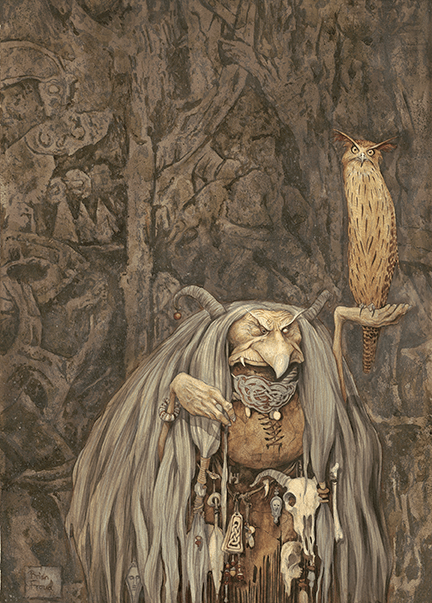
We are pleased to host the dynamic duo of Brian and Wendy Froud, artists and creators for The Dark Crystal, Labyrinth, and The Empire Strikes Back.
To discuss the art of Brian and Wendy Froud we must first cross into the Faerie Realm, so lets begin with Brians advice on where that enchanted place can be found: Faeries, says Brian, exist betwixt and between, inhabiting transitional spaces: in the liminal space at the edge of the woods; in the dusky light between night and day; in the imaginative place where our rational mind balances with the fluid irrational.
As artists, the Frouds are just as fluid and mutable as the faeries, working in the borderlands between a range of disciplines and genres: creating paintings, drawings, sculptures, dolls, puppets; and concept designs for book publication, exhibition, film, television and stage. What unites this work is an aesthetic vision, a Froudian style first developed by Brian as a young artist in the 1970s, and expanded in collaboration with Wendy over many years of creative partnership.
Brian was born in Winchester in 1947, raised in rural Kent, and studied at the Maidstone College of Art, where his childhood love of myth was rekindled by a book of Arthur Rackham illustrations found in his college library. After five years working as a commercial illustrator in London, Brian moved to a remote Dartmoor village where he shared a house with fellow-artist Alan Lee and his family. Inspired by the wild landscape around them, the two friends collaborated on Faeries, an illustrated book of British faery lore published in 1978. This ground-breaking volume quickly became an international bestseller and has influenced artists, writers and folklorists all around the world in the decades since. Brians magical vision so impressed American puppeteer and filmmaker Jim Henson that he asked Brian to come to New York to design two feature films: The Dark Crystal and Labyrinth. It was on the set of The Dark Crystal that Brian met Wendy, who created the gelflings and other creatures for the film.
Wendy was born in 1954 in Detroit, Michigan, where her parents were artists and teachers at the Art School of the Society of Arts and Crafts. I grew up sort of living in the art school, she says, and started making dolls around the age of five, as soon as I could bend a pipe-cleaner and bits of fabric together. After training in ceramics at the Center for Creative Studies, she moved to New York and landed a job in Jim Hensons Creature Shop, making puppets for The Muppet Show, The Muppet Movie, and fabricating Yoda for The Empire Strikes Back. She met and married Brian during the filming of The Dark Crystal. Their son Toby was born before filming on Labyrinth began, and he appeared in the film as the baby stolen away by David Bowies Goblin King.
After Labyrinth, the Frouds settled back on Dartmoor, rooting themself in a timeless landscape that still held a living faery tradition. Although they continued to produce designs and puppets for the screen (most recently for the Netflix television series The Dark Crystal: The Age of Resistance), they chose to give the bulk of their time to more intimate work: portraying their vision of the magic shimmering in the leafy green world around them. While Brian painted faeries, goblins and trolls, Wendy brought these same creatures to life in three-dimensional form. This work resulted in a long roster of books, including Brian Frouds World of Faerie, The Art of Wendy Froud, Good Faeries/Bad Faeries, A Midsummer Nights Faery Tale, Goblins, Trolls, Faeries Tales and the hilarious Cottington series of pressed fairy volumes. Brian is always quick to note that he is not an illustrator in the traditional sense of working from an authors text. In these volumes, the artwork always came first; the text was then written to elucidate the image, not the other way around. Terry Jones (of Monty Python fame) was one of the writers who worked with the Frouds in this manner (Lady Cottingtons Pressed Fairy Book, 1994), and I was another (the Old Oak Wood series, 1999-2003). More recently Wendy has taken this role herself, for who could be better at teasing out the stories that lie at the heart of her husbands paintings?
Although the Froudian art style begins with Brian and his life-long exploration of the Faerie Realm, its not quite right to say that Wendys contribution to the World of Froud merely echoes his. Rather, her art is in dialogue with Brians, and the two are in constant creative communication. Though they work in different mediums, and labor in separate studios, they keep coming together to show and discuss and argue and laugh, poking and prodding the best out of each other. Its such a fluid process that even I, who have worked with both, cannot tell where the line between them is drawn. They seem to share a muse who lives, like the faeries, betwixt and between.
"Inside the Writers House" invites you into the homes, offices, and writing rooms of acclaimed authors, providing an inside eye on their working life and a level of intimacy often lacking in more formal settings. An obvious reference to the televised Actor's Studio seminar, "Writers House" interviews are likewise craft focused, but strive for an earthy spontaneity unencumbered by prepared queries and index card cues. Visits are conversational and plastic, largely molded by (and dependent on) audience questions. In addition to the conversation, most visits include short readings, writing prompts, show-and-tell sessions, and house/apt tours. Chances are you'll meet their pets (and look inside their refrigerators).
In the last seven years, students have visited with almost 200 authors in dozens of different cities. Internationally, they've talked with Eoin Colfer in Dublin, Mariana Enriquez in Buenos Aires, Yewande Omotoso in Johannesburg, Garth Greenwell in Sofia, Karin Tidbeck in Stockholm, Kevin Barry in Sligo, and Daisy Johnson in Oxford. Stateside, they've talked with Maurice Ruffin in New Orleans, Karen Russell in Portland, Chigozie Obioma in Lincoln, Tommy Orange in Oakland, Susan Orlean in Los Angeles, Tom Perrotta in Belmont, Jeff VanderMeer in Tallahassee, and Eowyn Ivey in Palmer, Alaska (as well as more local, across-the-river luminaries like Jennifer Egan, Victor LaValle, Lev Grossman, and André Aciman).